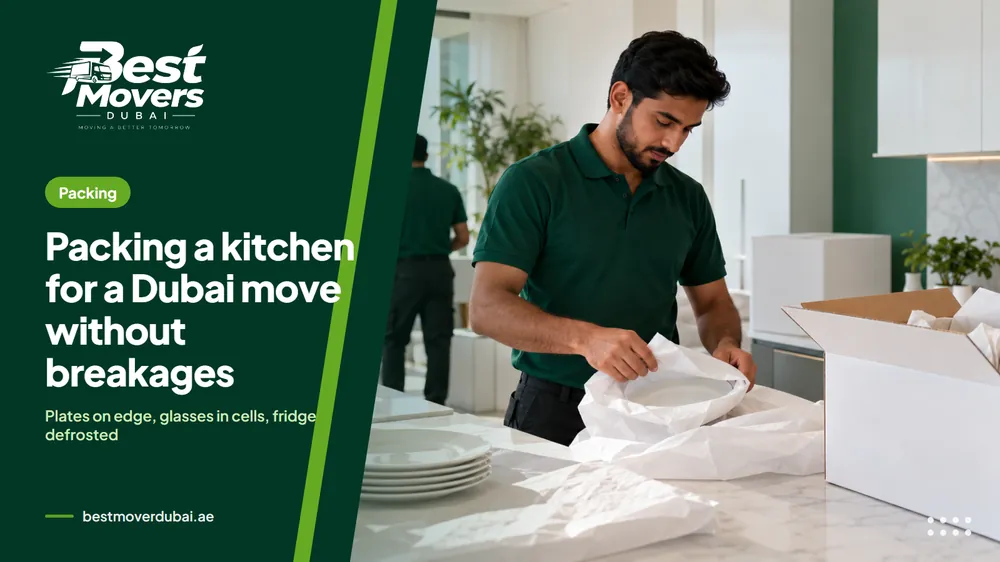
Packing a kitchen for moving takes longer than any bedroom and breaks more than any other room, and it is the first place you need working again at the other end. It is also the room most people leave until the night before, which is exactly when plates get stacked flat and glasses go into a carton loose.
Our packers work kitchens in a set order, and it is an order you can copy. Start with the cupboards you never open, move towards the kettle you used this morning, protect the two things that actually break, and keep one box out of the truck entirely.
Start Two Weeks Out With the Cupboards You Never Open
Nobody needs the fondue set, the second colander or the platter that only comes out for guests. Those go first, a fortnight before the truck, and the kitchen keeps working while they sit boxed in the corner. Pull the high cupboards and the back of the pantry onto the counter and be honest about what is travelling with you. Chipped crockery and scratched pans are not worth the carton.
Count what survives that cull, because the quote is built on what we see. A villa kitchen in Arabian Ranches with a pantry and an island can fill thirty cartons on its own, while a studio in Karama might take six. Give us the real number at the survey rather than the hopeful one.
- Box the rarely used things first: platters, spare dinner sets, appliances you never plug in
- Keep a working set out: two plates, two bowls, two glasses and one pan per person
- Donate or throw out chipped crockery instead of paying to move it
- Put anything you are selling online out for collection before packing day
Plates on Edge, Never Stacked Flat
This single habit prevents most kitchen breakages. A stack of plates lying flat in a box puts the weight of the whole load on the bottom plate, and one jolt in the truck cracks it. Stood on edge, like records in a crate, plates take that force through the rim where the china is strongest. Wrap each plate in paper, build bundles of three or four, then stand the bundles upright with padding underneath, over the top and down both sides.
Use small cartons for crockery and keep each one light enough to lift with two hands. A big box full of plates is a box that gets dropped at the lift. Bowls and mugs nest in threes with paper between them and ride above the plates, never below, and every gap gets filled so nothing slides when the carton is tilted onto a trolley.
Glasses and Stemware Belong in a Cell Box
A cell box, the carton with cardboard dividers that form a grid, was made for glassware and nothing else comes close. One glass per cell, wrapped in paper first, stems rolled rather than folded. Without dividers, glasses knock against each other at every roundabout, and paper alone will not stop it. Our crews carry cell inserts, and if you are packing yourself it is worth asking for a few with your boxes and tape.
Cut glass goes in its own carton, marked and loaded last so it travels on top. The forgotten ones are the tall items: jugs, blender carafes, glass storage jars and the coffee pot. Empty them, wrap them and give each one a cell rather than wedging it in beside the tumblers.
Knives, Pans and the Small Appliances
Knives travel point down in their block, wrapped and taped shut so the block cannot empty itself. Loose blades get laid on a folded tea towel, rolled, taped and labelled on the outside, so nobody finds the edge with a hand. Pans nest with paper between them and their lids packed separately on edge. For small appliances the original box is still the best box, and where it has gone, tape the cord to the body and bag the small parts inside the same carton.
- Knives rolled in cloth, taped shut and labelled on the outside
- Pan lids on edge in their own layer, not loose on top of the pans
- Baking trays and chopping boards stood down the side of a box as a stiff wall
- Blender jugs and coffee machine carafes padded separately from their bases
- Nothing under pressure in any carton: no aerosols, no gas canisters, no lighter fuel
Food, Spices and What the Heat Does to a Pantry
Start eating the cupboard down two weeks out. Plan meals around the rice, pasta, tins and frozen things already in the house. Open packets of flour, sugar, cereal and ground spices are rarely worth moving in Dubai, because anything already exposed to the heat and humidity comes out of the box stale or clumped. Sealed dry goods are fine and fit in one carton, packed upright.
Oil, vinegar, sauces and anything that can leak need their lids taped and a bag to themselves, standing up with a towel between the bottles. Nothing liquid shares a carton with crockery, glass or electricals. A truck can sit at a loading bay in the sun waiting on a lift slot, and any spill should be contained to that one bag.
Fridge and Freezer: Start the Evening Before, Not the Morning Of
The fridge catches people out because it needs time rather than effort. Run it down through the final week, then empty it, switch it off and leave both doors open the evening before with towels underneath. A freezer given only a couple of hours is still dripping when it goes up the ramp, and a damp fridge shut inside a hot truck smells of it for weeks.
Wash the shelves, wrap the glass ones in paper and pack them flat, and tape the drawers or box them. At the new home the fridge stands upright for a few hours before it goes back on, longer if it travelled on its side, so get the DEWA move in and move out requests in early and have the power running before the truck arrives. Our guide to moving in Dubai in summer covers what the heat does to your other appliances.
The Box You Open First, and Who Packs the Rest
One carton never gets stacked with the others. It holds what you need in the first two hours in the new kitchen, it is marked on all four sides, and it rides in the car if there is space. Packed properly, the kettle is on while the crew is still bringing in the sofa, rather than six boxes cut open on the floor in search of teaspoons.
Label every other kitchen carton with the contents as well as the room, and add "this way up" on anything packed on edge. If you would rather hand the whole room over, our packing and unpacking service packs the kitchen first and comes back to open it, with the cartons and paper taken away the same visit. If the boxes are already done and you need only the lifting and a vehicle, our removal service covers that. What belongs in the box you open first:
- Kettle, mugs, tea, coffee, sugar and teaspoons
- One knife, one chopping board, one pan and a serving spoon
- Washing up liquid, a sponge, a cloth and bin bags
- Kitchen roll, a roll of tape and a pair of scissors
- Plates, bowls and cutlery for everyone, plus a bottle opener