Books and paper are the two things people underestimate every time. A carton that holds a duvet with room to spare becomes impossible to lift once it is full of hardbacks, and one shelf of lever arch files can weigh more than the shelf it sat on. Moving documents in Dubai brings a second problem on top of the weight: some of that paper cannot be replaced, and a few pages of it decide whether a new tenancy, a school place or a visa renewal goes through on time.
There are really three kinds of paper in a move. Books and magazines, heavy but replaceable. Files and archives, which are only worth anything in the right order. And a small pile of originals that should never see the inside of a truck. Each one needs a different box, and the third needs no box at all.
Why Books Go in the Smallest Carton We Carry
Paper is dense. A small carton of around 40 by 30 centimetres, packed to the top with books, is already as much as one person should lift up a flight of stairs. Put the same books in a wardrobe carton and nobody can pick it up, the base gives way in the lift lobby, and you are collecting paperbacks off the floor of a shared corridor.
The rule is easy: small and heavy is packed right, large and heavy has to be repacked. At a survey we count shelf metres rather than boxes, because thirty metres of shelving says more about the carton order and the crew than a room count does. Mention the library when you request a free quote.
- Small double walled cartons for books, never wardrobe boxes
- Tape the base twice, along the seam and across it
- Pack to the top so the lid does not sink under the box above
- Keep every box to a weight one person can carry alone
Packing Books so Spines and Covers Come Out Clean
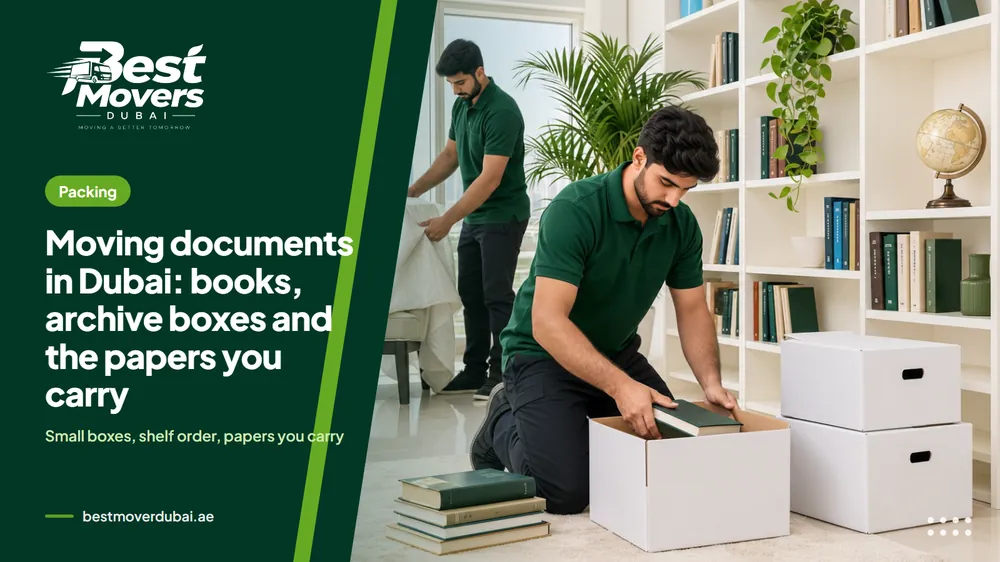
Stack hardbacks flat, in layers, heaviest at the bottom. Paperbacks can stand spine down, the way they sat on the shelf, but never spine up, because the pages pull away from the glue under their own weight. Leave no gaps. A loose box lets books slide, and sliding is what rounds off the corners of a dust jacket.
Anything with real value gets wrapped on its own: first editions, signed copies, leather bindings, a Quran or any book that matters to the family. Clean white paper first, then bubble wrap, then into the middle of the carton with padding on all sides. Photo albums lie flat. Framed certificates travel upright and face to face, not stacked like plates.
Files and Archives Are Only Useful in Order
A box of files in the wrong order costs more time than a broken plate. Keep the sequence the shelf already had: pack left to right, top shelf first, and write the range on the lid, for example 'Accounts 2021 A to K'. Archive boxes with lids beat plain cartons here, because they stack square and go straight onto a shelf at the other end.
Lever arch files are heavy and their metal corners dig into each other. Stand them upright, spines facing the same way so the labels read in a line, and fill the last gap with flat card instead of leaving it open. Hanging files can stay in their frame if the cabinet travels loaded, or go into a file box in the same order if it does not.
- Pack in shelf order, left to right and top shelf down
- Write the contents range and the destination room on the lid
- Spines one way, so the labels read in a line
- One shelf or one drawer per box, never two mixed together
- Number the boxes and keep a list of what each one holds
The Documents That Travel With You, Not on the Truck
Some paper should not leave your hands. Passports and Emirates IDs for everyone in the family, the tenancy contract and the new Ejari certificate, visa papers, attested degree and marriage certificates, birth certificates, car registration and insurance, title deeds, bank and medical records, school reports and transfer certificates. One folder, in a bag that rides in your car, checked before the truck pulls away.
Attested documents are the ones to be careful with, because replacing an attestation takes weeks and usually involves another country. Scan every page the week before and keep the copies where a phone can reach them. A scan will not stand in for an original at a government counter, but it tells you exactly what is missing.
- Passports, Emirates IDs and visa papers
- Tenancy contract, Ejari and the landlord's receipts
- Attested certificates: degrees, marriage, birth
- Car registration, insurance and service history
- School reports, transfer letters and vaccination records
Offices and Clinics: Records That Have to Be Accounted For
In an office move the paper gets serious, because a named person is answerable for it. Client files, HR records, signed contracts, trade licence papers and audit files all have to arrive complete, and in a regulated business they have to be accounted for in transit too. We label archive boxes by shelf as much as by room, number every one and hand the list over, so your office manager can tick them back in. Our office and commercial removals are planned that way as standard.
Agree two things before packing day: who seals and signs for confidential boxes, which is usually the person who owns the records rather than anyone on the crew, and what is leaving as waste. Shredding is a separate job with its own timing. Our IT checklist for an office relocation covers the machines and the cables.
Heat, Damp and the Hours in Between
Paper has a hard time in Dubai. Trucks stand in open car parks, loading bays are not air conditioned, and a carton of books left on a balcony for one afternoon comes back warped. Keep boxes out of direct sun, out of a hot car boot, and indoors as soon as they land. If the cooling at the new address is not running yet, sort that out before moving day.
Damp is the quieter risk. New buildings, ground floor stores and the back of a garage all hold more moisture than a living room, and paper draws it in. If books or files are going into storage between two leases, ask for a ventilated unit, keep the boxes off the floor and do not seal paper inside plastic bags.
Before the Lids Go On
Books are the easiest thing in a home to thin out and the most expensive thing to pay for twice. Pull the ones you know you will not open again and pass them on while there is time: community groups, school libraries and charity collection points all take them. Then note which box holds the files you need in the first week, give the carry folder to one person, and look behind the empty shelves before the keys go back.